
Drought Monitor: Area Of Extreme Drought Creeping Into Iowa
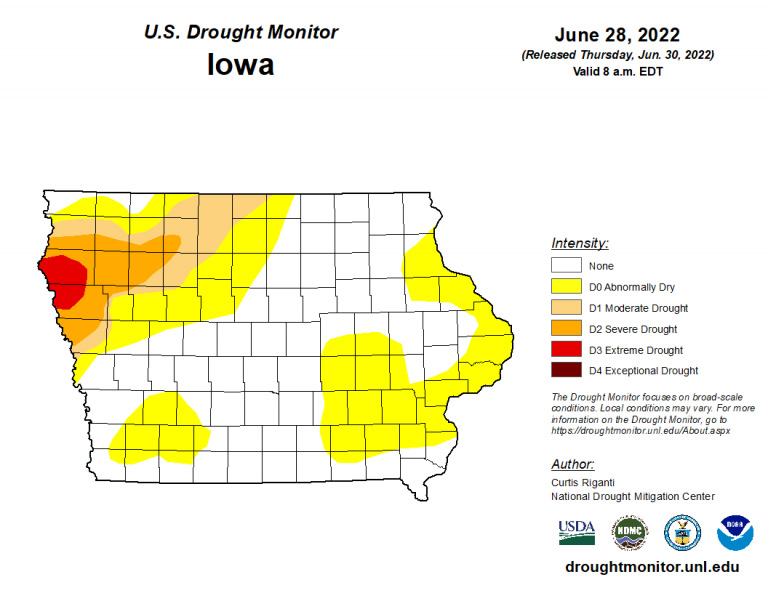
The latest crop report still shows good progress in much of the state, but the dry conditions are becoming more of a concern, especially in the Sioux City and Le Mars areas.
In the latest report, statewide topsoil moisture conditions rated 3 percent very short, 17 percent short, 74 percent adequate, and 6 percent surplus. Subsoil moisture conditions rated 4 percent very short, 19 percent short, 73 percent adequate, and 4 percent surplus.
Corn condition rating was 83 percent good to excellent. Ninety-three percent of soybeans have emerged, 6 days behind last year but 3 days ahead of average. Iowa’s soybean condition rating was 80 percent good to excellent. Sixty-two percent of the oat crop has headed, 3 days behind last year. Iowa’s oat condition remained at 82 percent good to excellent.
In northwest Iowa specifically, topsoil moisture was 20 percent very short, 33 percent short, 45 percent adequate, and 2 percent surplus, while subsoil moisture was rated 18 percent very short, 29 percent short, 50 percent adequate, and 3 percent surplus.
According to the US Drought Monitor at the University of Nebraska, Lincoln, the conditions vary in northwest Iowa. It says that over the last week, an area of extreme drought has crept into the area just southwest of the O’Brien County area. It straddles the rivers in the Sioux City area into both extreme southeast South Dakota and extreme northeast Nebraska, covering much of Plymouth County and nearly the northwest half of Woodbury County. The area is bordered by an area of what is termed “severe drought,” which along with other areas, covers about the southern half of Sioux and O’Brien counties and all of Cherokee County. A little further north, roughly the northern halves of Sioux and O’Brien counties are in moderate drought. About half of Osceola County and the southeast half of Lyon County are only “abnormally dry,” with the remaining parts of those counties not under drought conditions at all.
Statistics for O’Brien County show: 11,285 people affected by drought. No change since last week and up 100 percent since last month; 8.4 percent of people are affected by drought. No change since last week and up 78 percent since last month. O’Brien county was 59th driest for May on record over the past 128 years, down 0.31 inches from normal. The county was 40th driest year to date over the past 128 years (January-May 2022) down 1.51 inches from normal.
The U.S. Drought Monitor (USDM) is updated each Thursday to show the location and intensity of drought across the country using a five-category system, from Abnormally Dry (D0) conditions to Exceptional Drought (D4). The USDM is a joint effort of the National Drought Mitigation Center, USDA, and NOAA. Following are the conditions experienced inder those categories and the percentage of O’Brien County included under each cetegory.
D0 – Abnormally Dry
Corn shows drought stress; soil is dry
100.00% of O’brien County (D0-D4)
D1 – Moderate Drought
Soybeans abort pods; corn test weights are struggling
Grasses are brown; more grass fires occur; burn bans are issued
Pond levels decline
78.38% of O’brien County (D1-D4)
D2 – Severe Drought
Dryland corn has extremely low yields; commodity shortages are noted; livestock is stressed
Fire danger is high
Surface water levels are low; algae blooms increase; voluntary water conservation is requested
37.67% of O’brien County (D2-D4)
D3 – Extreme Drought
Pastures are dry; producers sell cattle; crops are tested for toxins; crops have pest infestation
Trees drop leaves; acorns are underdeveloped
Warm water leads to fish kills; streambeds are low to dry
0.00% of O’brien County (D3-D4)
D4 – Exceptional Drought
Row crop yields and forage production have significant impacts
Extreme measures are taken to conserve water
Aquatic invertebrates in waterways increase
0.00% of O’brien County (D4)
Agriculture in O’Brien County
The USDA’s National Agricultural Statistics Service (NASS) conducts hundreds of surveys every year and prepares reports covering virtually every aspect of U.S. agriculture, including agricultural commodities statistics for crops and livestock. Estimates for O’Brien County are:
115,581 acres of corn in drought (D1–D4)
102,008 acres of soybean in drought (D1–D4)
2,716 acres of hay in drought (D1–D4)
395,312 number of hogs in drought (D1–D4)
12,404 number of cattle in drought (D1–D4)
The Water Supply for the State of Iowa indicates:
18 percent of streamflow sites are below normal in Iowa
3 percent of streamflow sites are above normal in Iowa
0 percent area of Iowa with above normal precipitation probability this month
57 percent area of Iowa with below normal precipitation probability this month