
Sharing Rural Roads with Farm Equipment Requires Patience and Caution
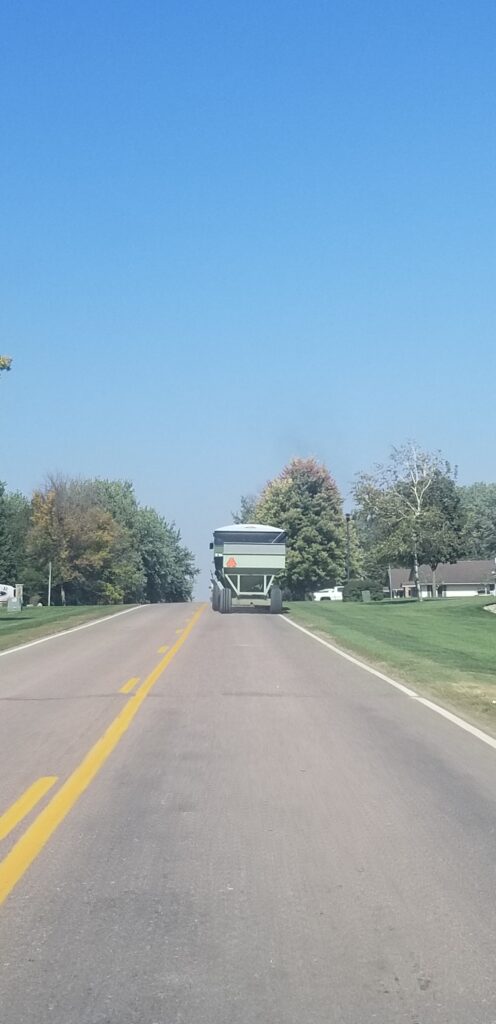
With harvest season underway, expect to encounter slow moving equipment. Favorable weather in the forecast has farm equipment and motorists back on Iowa’s roadways, and with that combination comes the need for patience and caution.
If you’ve driven on Iowa’s rural roads, you know how your spine tingles when you pop over a hill and come upon a slow-moving tractor. A split-second reaction can save you from a collision.
Each year, Iowa farmers move nearly two billion bushels of grain and millions of livestock from production to market, much of it on the county and state highway system. Because all Iowans share the same roads, it helps to know what to look for. Some common ways farm vehicles are involved in traffc collisions. Defensive driving tips are given for each situation.
At least half of all deaths from unintentional injuries are caused by motor vehicles. According to the National Safety Council, this represents about 40,000 deaths per year on average. It is also known that collisions with farm equipment are some of the most likely collisions to end in a fatality. It is important to be aware of the common types of collisions and how to take preventative action to avoid them. It is a shared responsibility of all vehicle operators to make Iowa roads safe.
The most common incidents occur when an approaching motorist hits a farm vehicle from behind or when a passing motorist hits a farm vehicle that is attempting to make a wide left turn. Like semi-truck drivers, operators of large farm vehicles, such as combine or tractor-wagon combinations, sometimes make wide left turns. Farm operators may swing to the right before making a left turn because they need the extra room to line up with a farm gate or driveway. This can be confusing, especially if you think the farm operator is moving over to let you pass.
It takes a combined effort to keep Iowa’s roadways safe.
Advice for everyone is to remember that they share the roadway with others, to always drive defensively, and also make sure all vehicles and equipment are properly marked, and that operator intentions are clearly communicated.
It requires everyone if we are going to make the roads safer. Motorists need to slow down and be patient, and farmers need to make sure their equipment is marked and their intentions are recognized.
For the cars, SUVs and pickups travelling the road, remember it is difficult to react when coming upon slower equipment. The smaller size of your auto makes it harder for equipment operators to see you. Be prepared for farm vehicles. Farm vehicles travel significantly slower than automobiles. Be prepared to slow down and follow; you may not have room to pass. You may only have a few seconds to react and slow down before overtaking a farm vehicle. It is hard but slowing down and being patient is extremely critical during this time of year. Slow down and keep your distance. Don’t assume that the farmer can pull over and let you pass. Shoulder conditions may make it unsafe for the farmer to pull heavy equipment to the side of the road. Never pass farm equipment while in no-passing zones. When passing slower large equipment use your turn signals to let the equipment driver know you are passing and make sure you can see the farm vehicle in your rear-view mirror before you get back in your lane.
In addition, do not forget that sometimes this equipment will be turning into field driveways – not just onto another road. Drivers need to be aware is it really turning? Don’t assume a farm vehicle that pulls to the right side of the road is going to turn right, or is letting you pass. Be sure of the farmer’s intentions before passing. Don’t assume that a farm vehicle is turning right or pulling over to let you pass if it pulls to the right side of the road. A farmer may have to swing right in order to make a left turn. Wait until you know what the farmer is planning to do. Check for operator’s hand signals or a turn signal. Look for a tractor turn signal and do not be confused by fashing hazard lights. Slow down when you see a turn signal. Where could it turn? Check the left side of the road for gates, driveways, or any place a farm vehicle might turn. Be alert. Always watch for farm vehicles on rural roads, especially at planting and harvest. Slow down immediately. As soon as you see a slow-moving vehicle, start to apply brakes like you would when approaching a stoplight. It’s easy to misjudge speed when you come upon a slow-moving vehicle. In most cases, you have only a few seconds to react and slow down. For example, if you’re driving 55 mph and come upon a tractor that’s moving 15 mph, it only takes fve seconds to close a gap the length of a football feld between you and the tractor. Keep your distance. Stay a safe distance behind farm vehicles. Stay back at least 50 feet when following farm equipment. Most farm equipment is not designed to travel at speeds greater than 25 mph. Even when towed behind a truck, equipment such as sprayers and fuel tanks often travel less than 25 mph. Be patient and enjoy the scenery if you find yourself following a farm vehicle. Even if you have to follow a farm vehicle for a couple of miles, it will only take a few minutes of your time. Be especially alert in the evenings; farmers are returning from the fields and dusk makes farm vehicles more difficult to see.
Learn to recognize the Slow moving vehicle sign (SMV) it means slow down because the vehicle is traveling less than 35 mph. Slow moving vehicle (SMV) emblems are forescent orange outlined in red. You should be able to see them at least 500 feet away.
Some tips for farmers operating machinery would include being certain ‘Slow Moving Vehicle’ (SMV) emblems are bright and clean, Make sure farm machinery is equipped with the lighting and marking safety devices recommended by the American Society of Agricultural Engineers and required by state and local laws. Be sure to remind all operators to use the appropriate hazard lights and turn signals when traveling on roads. Make sure all equipment is well lit with frequent checks to ensure the lighting is working and use signal lights before making any turns – especially when pulling right to make a wide left-hand turn. Use mirrors to monitor the surroundings and try to travel on less busy roads. Dusk and dawn travel avoidance is encouraged because visibility is reduced, so if possible, move equipment when it is light outside. Maybe consider having a pilot car escort you from field to field especially when equipment is wide or high.
Only allow licensed, or appropriately trained, operators to take farm machinery onto the road. Youth who are able to operate machinery in the field may not be able to deal safely with traffic and other road hazards. Minimize total vehicle width and secure equipment in the transport position before entering roadways. Watch for approaching traffic and vehicles trying to pass. If possible, pull over and let traffic pass safely, but be alert for roadside hazards. Obey all traffic laws and signs. Signal intentions to motorists and avoid sudden or unexpected maneuvers. Exercise additional care when entering roadways, approaching unsigned or “blind” intersections, crossing narrow bridges, going around sharp corners or going over hills.
Farmers who veer to the right of a roadway may actually be preparing to make a left-hand turn. If possible, farmers and motorists should try to make eye contact when turning or preparing to pass, and both should be cautious about making any assumptions.
Stress on farmers and travelers reduces our decision-making skills, which could put us all at risk. Iowa roads can be used safely by everyone. To help you enjoy your time on Iowa roads or make your work commute safer, remember these tips. Many collisions with farm vehicles happen during fall harvest. October has nearly twice as many collisions as any other month. The most common time of day for collisions to occur is from 4–8 p.m. This may be due to the large number of commuters coming home from work, plus farm operators returning from fields. Plan on longer times to get to your destination and be PATIENT while traveling there.